Operations · the core loop

From request to
after-action.

One operation. End to end.

How it runs

A single thread, start to finish.

An operation on Overwatch is one continuous record. The client's request, the operators you assign, the site, the brief, the voice notes from the field, the encrypted comms, the after-action report — all of it hangs off the same thread. Nothing falls through the gap between five different tools, because there's only one.

01

Request

The client asks for protective work, in a few taps.

02

Plan

Staff it, attach intel, tie it to a site, draft the brief.

03

Run

Eyes on. Live tracking and one-tap field notes.

04

Debrief

The after-action report drafts itself from the op.

05

Learn

Lessons feed back into the firm for the next mission.

01 · Service Requests

It starts with the client.

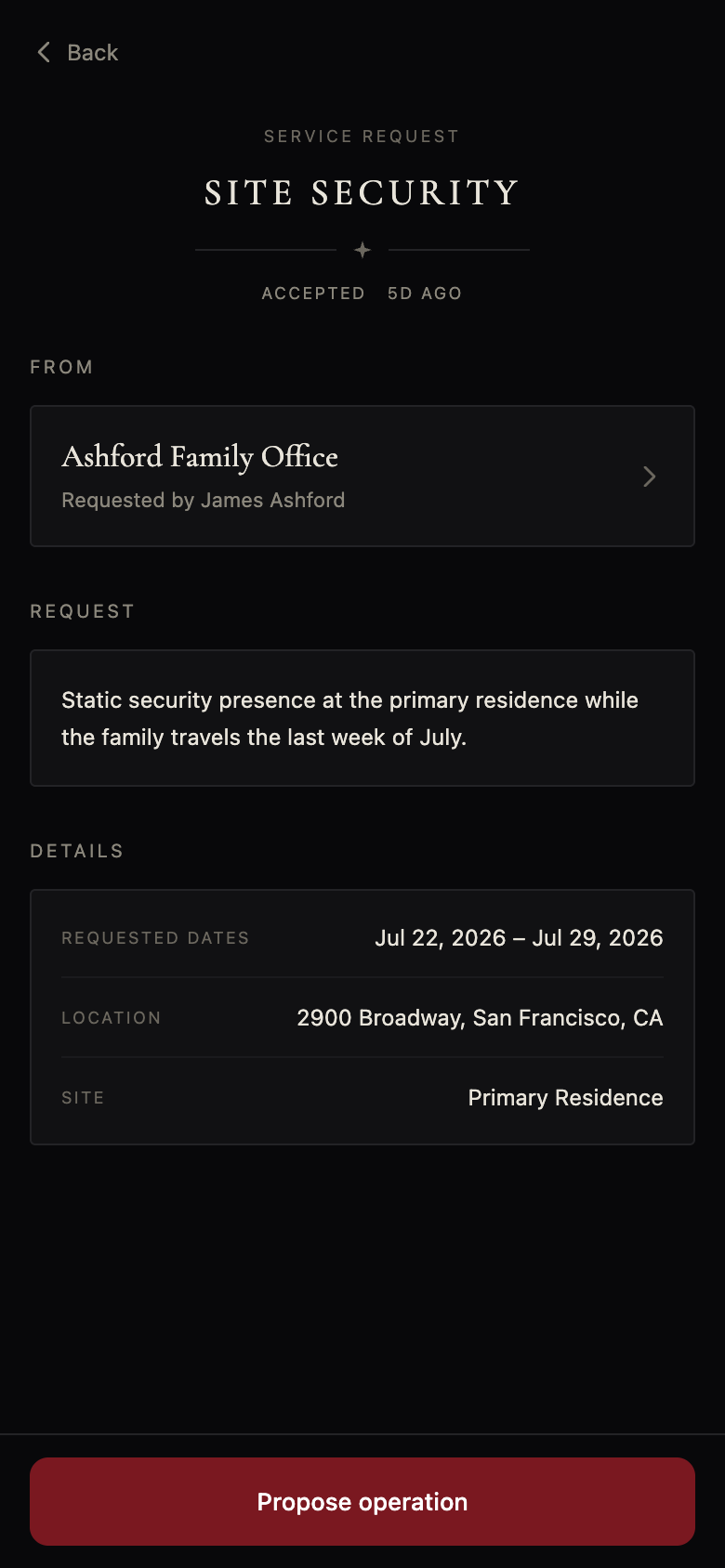
Your client opens their app and requests protective work — a detail, an event, a recon — in a few taps. It lands in your queue with the type, the place, and the window already attached. One tap turns that request into a proposed operation, scoped and ready to staff.

  • Client-initiated. Requests come straight from the people you protect — no phone tag, no email chains.
  • Request to proposed operation in seconds. The context carries over; you accept, decline, or convert.
  • Dealflow, not back-and-forth. Lower the friction to ask and one-off jobs become standing engagements.
Built around the people you protect Client Experience
Placeholder
incoming request
EP DetailRequested
Where · When
Convert to operationDecline
Visual — client request → proposed op
02 · Planning

Stand up the operation.

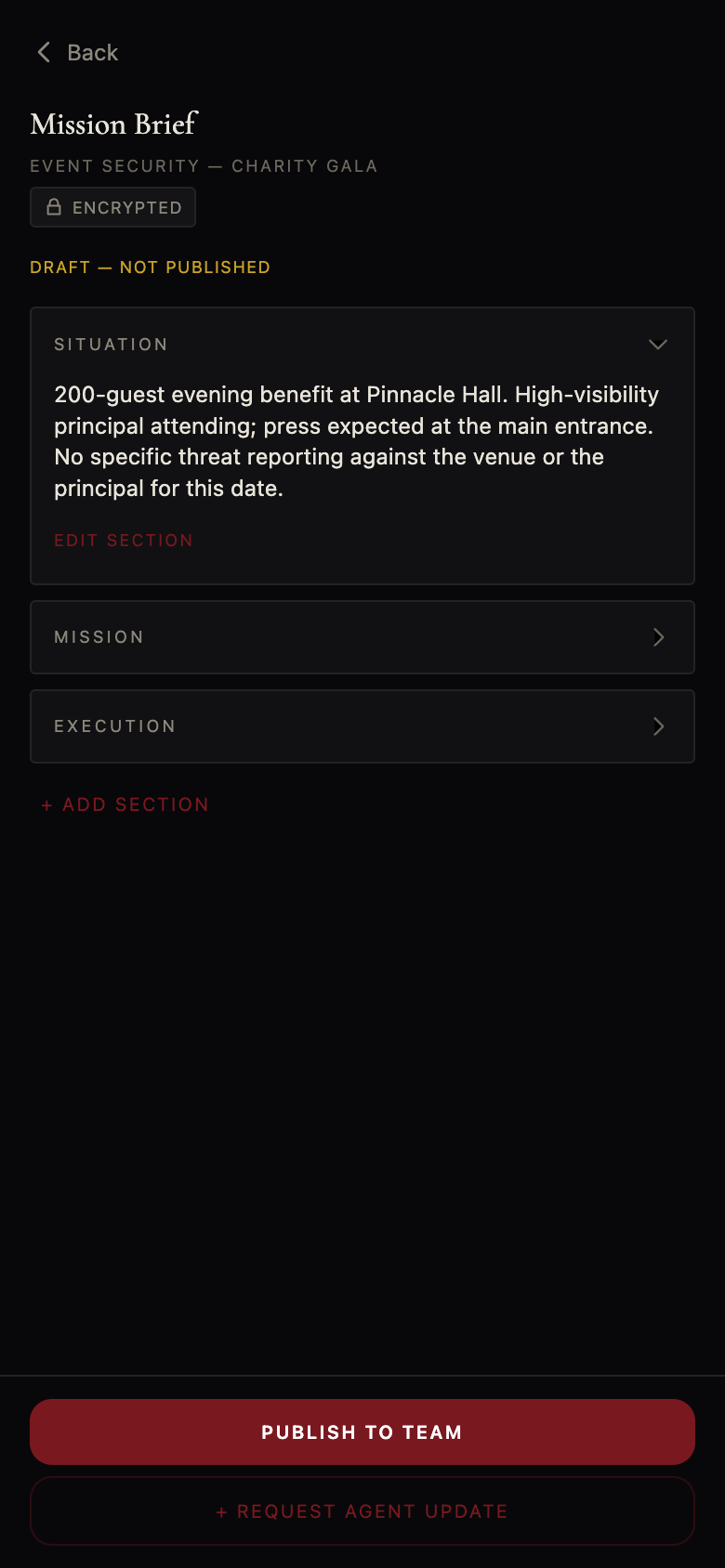
Assemble it in one screen. Assign your lead, operators, and support; attach the intel, photos, and PDFs that matter; tie it to a site. Then let Overwatch draft the brief.

  • Roles that mean something. Lead, operator, support — each with the access the job needs, nothing more.
  • Attachments read for you. Drop in images and PDFs; the platform extracts what's inside so the brief can use it.
  • AI mission brief. A full SMEAC brief — Situation, Mission, Execution, Admin & Logistics, Command & Signal — drafted in seconds from the site, the attachments, your intel, even the weather.
  • Yours to edit. Iterate with plain-language instructions, then lock it when it's set.
Placeholder
mission brief · generating
LOOSSite linked
Situation
Mission
Execution
Visual — AI-drafted SMEAC brief
03 · Sites

Every place, on file.

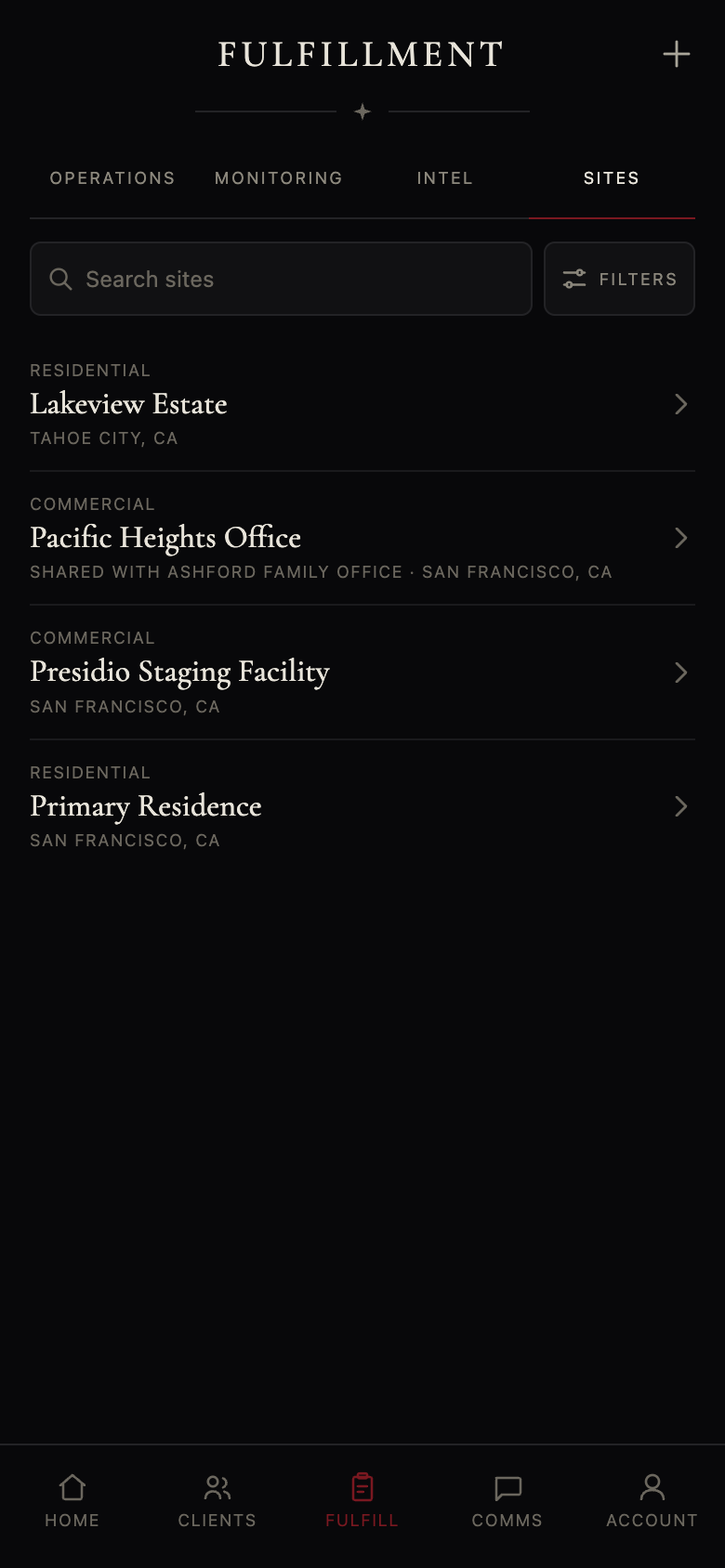
The residence you cover every week, the hotel a principal always uses, a one-off venue — keep them in a site library you build once and reuse. Each site carries its address, access notes, nearest hospital, points of contact, and a threat & vulnerability assessment.

  • Firm-wide or engagement-specific. A common venue or hotel for everyone — or a principal's home, scoped to one client.
  • TVA captured per site. Threat and vulnerability assessment lives with the location, not in someone's head.
  • Folds into the brief. Pick a site and its intel becomes part of the mission brief automatically.
Placeholder
site directory
Firm-wideEngagement
Hospitality · TVA on file
Residential · access notes
Venue · nearest hospital
Visual — reusable site library
04 · In the field

Eyes on, live.

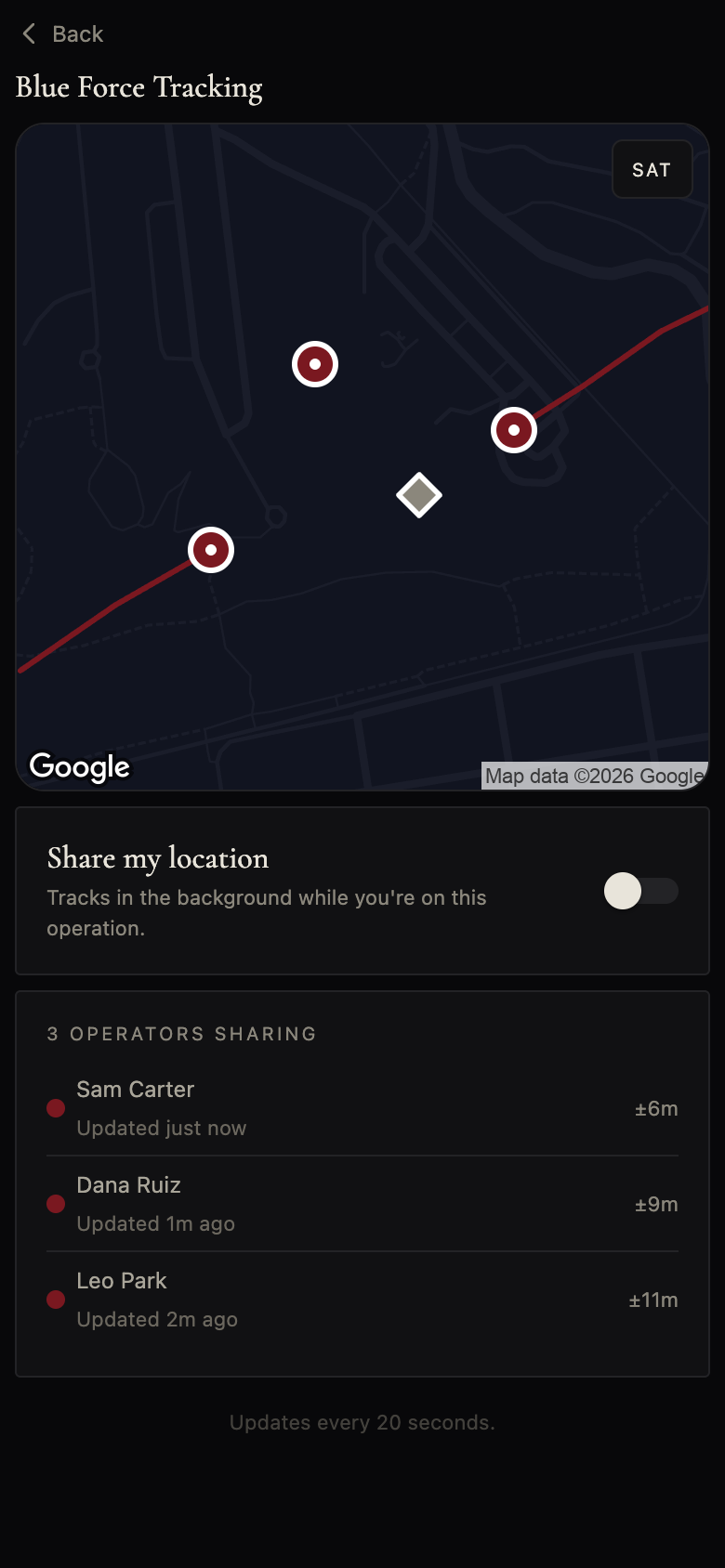
When the operation goes active, the field and the command post stay in sync. Capture what's happening with one tap, and see where your people are in real time — without turning your operators into a surveillance feed.

  • One-tap voice notes. Operators capture what happened without typing — transcribed and waiting for the after-action.
  • Blue force tracking. Every assigned operator on a live map while the op runs.
  • Location is ephemeral and opt-in. Operators choose to share, positions expire within the hour, and nothing is kept long-term.
Placeholder
Visual — live map · ephemeral positions
05 · Comms

Two rooms, zero visibility.

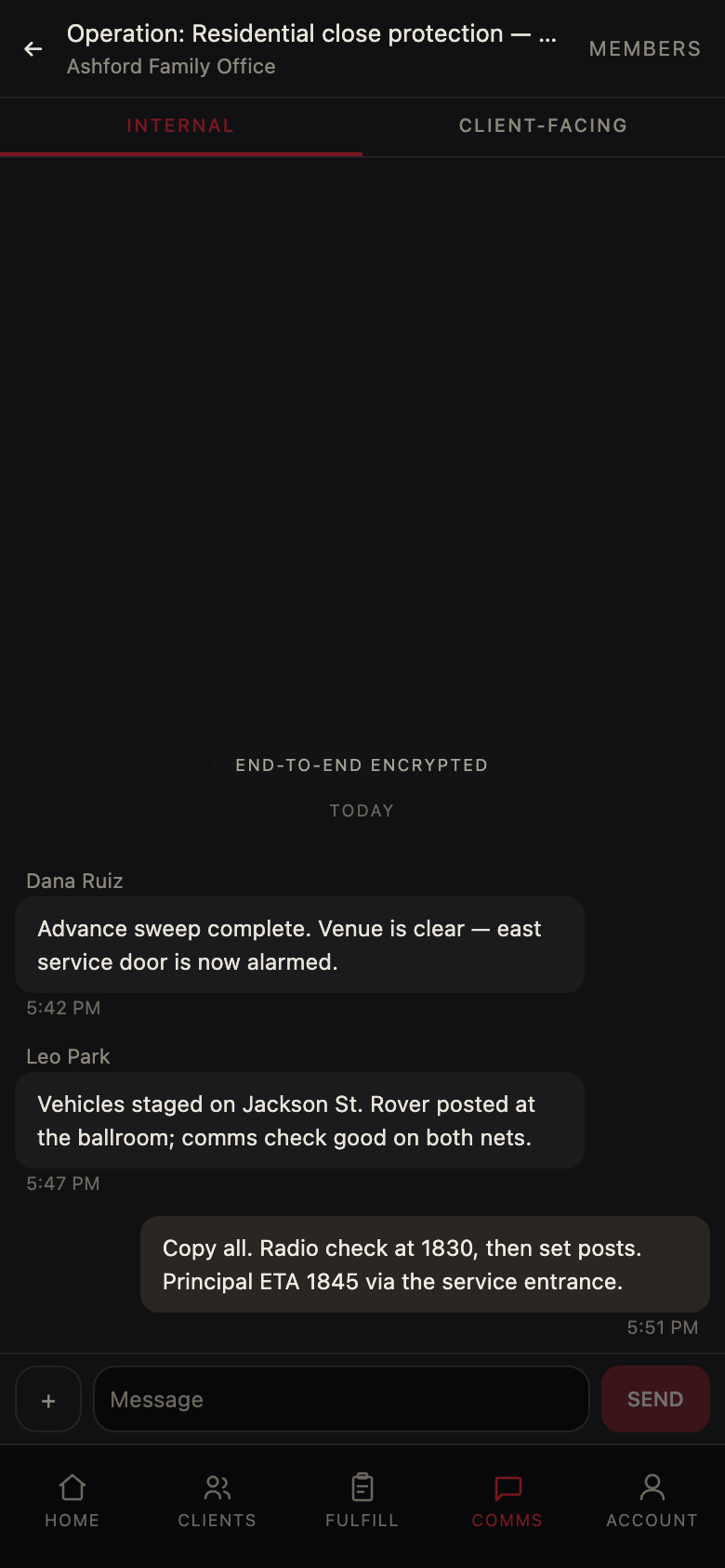
Every operation gets its own channels: an internal room for your team, and a shared room with the client. Both are end-to-end encrypted with keys that live on your devices — we relay the messages and cannot read a word of them.

  • Internal + external rooms per operation. Your team's channel stays your team's; the client only sees the client room.
  • End-to-end encrypted with device keys. The server only ever holds ciphertext — there's no copy for us to read or hand over.
  • Access follows the assignment. Change who's on the op and who can see the room changes with it.
Why we can't read your messages Privacy
Placeholder
internal room · encrypted
End-to-end encrypted
Visual — internal & client rooms
06 · After-action

The mission doesn't end at exfil.

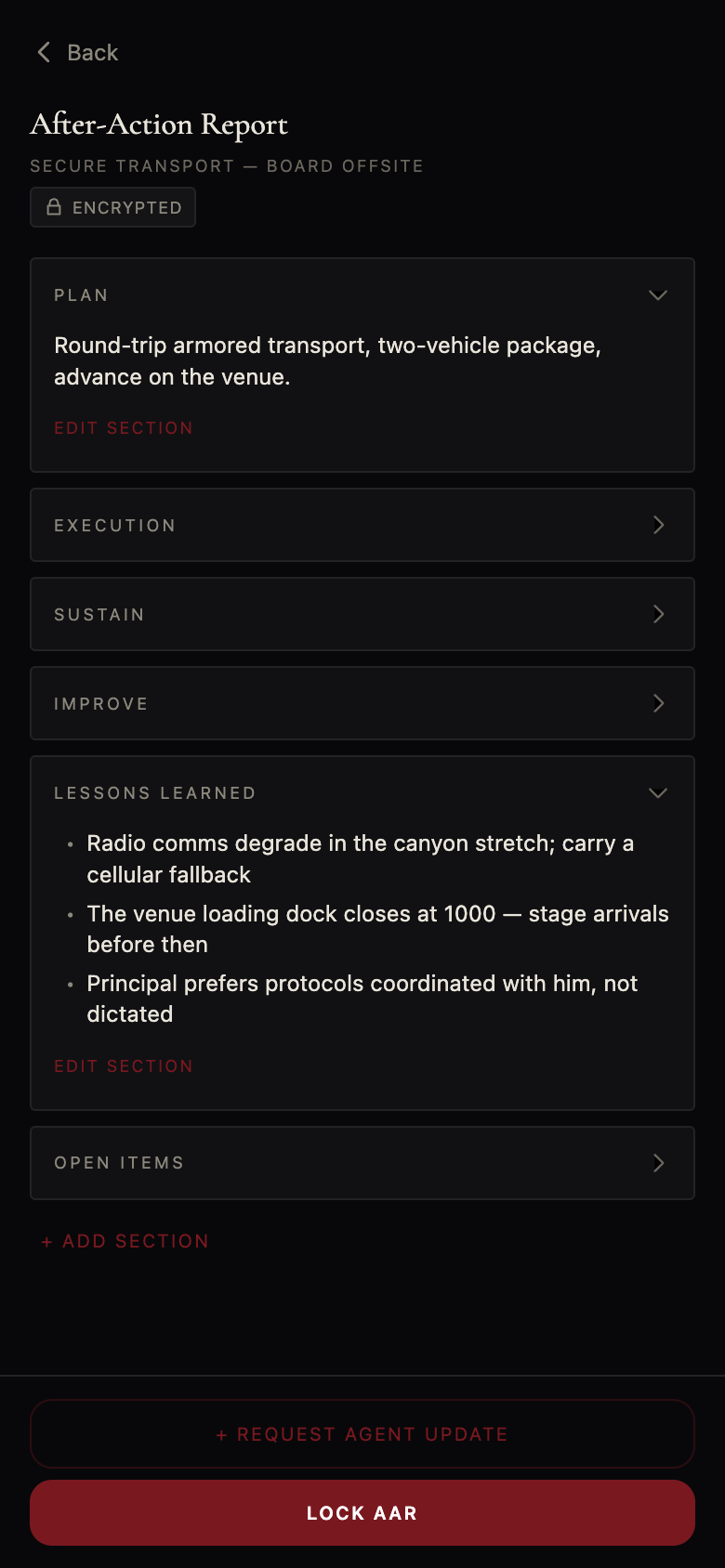
When the operation closes, Overwatch drafts the after-action report for you — pulling in the voice notes your team captured in the field automatically. Then it does something a PDF never could: it learns.

  • AI-drafted AARs. The report writes its first draft from what actually happened on the op.
  • Voice notes pulled in automatically. Nothing said in the field gets lost between the op and the write-up.
  • Institutional knowledge. Every AAR feeds lessons back — firm-wide doctrine that sharpens every future mission, and engagement-specific nuance that improves the next job for that client.
Where that knowledge lives Intelligence
Placeholder
after-action report · draft
3 voice notes pulled in
Execution
Lessons learned
Firm-wideThis engagement
Visual — AAR + knowledge extraction
From request to after-action

See the whole loop.

We'll walk you through a single operation end to end — request, brief, field, debrief — with your workflow on the screen.

Or email hello@overwatch.group